1886-1895
-
British Liberalism and Irish Nationalism
Review of Eugenio Biagini, British Democracy and Irish Nationalism, 1876-1906 (Cambridge University Press, 2007).
-
‘A dynamic force is a terrible thing’
Review of Martin Pugh, Lloyd George (Longmans, 1988).
-
The Liberal Party: Triumph and Disintegration 1886-1929
Review of G. R. Searle, The Liberal Party: Triumph and Disintegration 1886-1929 (Macmillan, 1992).
-
Gladstone’s Newcastle Speech – The Future Policy of the Liberal Party
Gladstone’s Newcastle speech of October 2nd, 1891 to the Annual Meeting of the National Liberal Federation.
-
Gladstone’s 1886 Manifesto
As appeared in The Times on Monday June 14th 1886.
-
The Newcastle Programme
The general election of 1885 was the first fought on the enlarged franchise of the third reform act and the first in which the parties competed for the votes of large numbers of agricultural workers. This stimulated both a new political debate and the development of campaigning techniques which would inform the next election.
-
Gladstonian Liberalism
Few statesmen left a deeper and more permanent mark on British Liberalism than William Ewart Gladstone (1809-1898). What secured a unique place for him in the history of Liberalism was not simply the fact that he was Prime Minister four times (1868-74, 1880-85, 1886 and 1892-94), having previously served as Chancellor of the Exchequer for…
-
Leonard Trelawney Hobhouse, 1864-1929
Leonard Trelawney Hobhouse, born at Liskeard, Cornwall on 8 September 1864, came from a long line of Anglican clerics. His father, the Venerable Reginald Hobhouse, was Rector of St Ive, near Liskeard, a position he had obtained through his political connections with Sir Robert Peel. His mother was a Trelawney from the prominent West Country…
-
David Lloyd-George (Earl Lloyd-George and Viscount Gwynedd), 1863-1945
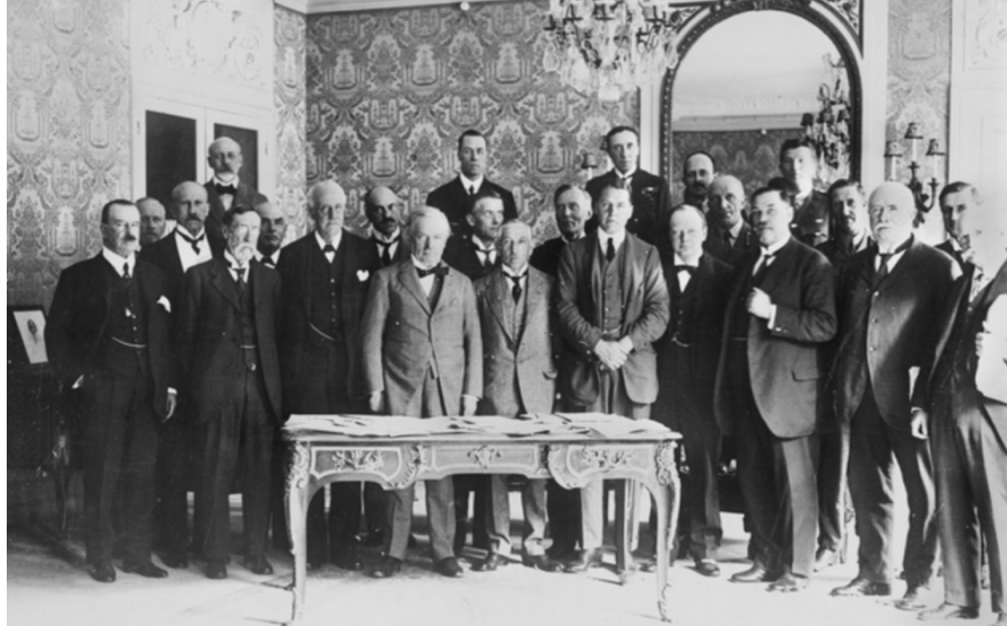
[…]The pinnacle of Lloyd George’s career was the peace-making at Paris in the first half of 1919, leading to the Treaty of Versailles, signed on 28 June 1919. While rightly criticised in many aspects (such as the war guilt clause, the scale of reparations and many boundaries), Lloyd George tilted the settlement in a more…