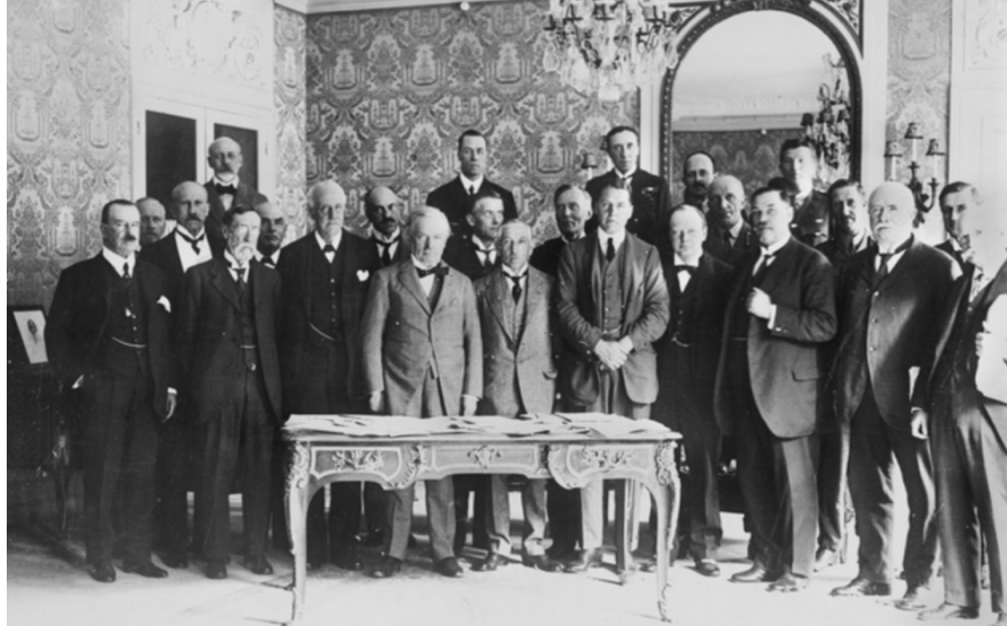
England Objects to the Treaty of Versailles, June 1, 1919

Journal of Liberal History

1859-1886

  • Charles Bradlaugh, 1833-1891

    Charles Bradlaugh was born on 26 September 1833 in Hoxton, London, the eldest of the seven children of a poor solicitor’s clerk, and he received only an elementary education. Though brought up in the Church of England, he came to doubt the doctrines of Christianity. Pressure to conform drove him from home in 1850 and…

  • Joseph Chamberlain, 1836-1914

    In a picture postcard (Tuck & Sons Ltd, c. 1905) Radical Joseph was pictured wearing a coat of many colours. Each segment was labelled with different stages in his political career: socialist, extreme radical, Gladstonian, Liberal Unionist, Conservative and protectionist and food taxer. Inconsistent was one of the more favourable epithets used of Chamberlain. To…

  • William Edward Forster, 1818-1886

    W. E. Forster was a typical nineteenth century Radical: a successful self-made businessman of nonconformist origins who was driven by his conscience to work for the less well-off in the community. His great achievement was the successful creation of the framework for a state education system which is still recognisable today. His ill fortune was…

  • The Age of Russell and Palmerston, 1846-1868

    The collapse of Sir Robert Peel's Conservative government, following the 1846 repeal of the Corn Laws, began a complex re-arrangement of British political parties; one that took more than a decade to complete. Paradoxically, by rejecting Peel, the remaining Tories held the advantage of unity in their desire to protect agricultural interests and the established…

  • Times report on the meeting in Willis Rooms

    The following report from The Times describes the meeting that took place at Willis' Rooms in St James Street, London on the 6th June 1859, when the Liberal Party was finally formed.

  • Personal account of the meeting in Willis’ Rooms

    The following letter from Sidney Herbert to his wife is a personal account of the meeting that took place at Willis' Rooms in St James Street, London on the 6th June 1859, when the Liberal Party was finally formed.

  • Gladstonian Liberalism

    Few statesmen left a deeper and more permanent mark on British Liberalism than William Ewart Gladstone (1809-1898). What secured a unique place for him in the history of Liberalism was not simply the fact that he was Prime Minister four times (1868-74, 1880-85, 1886 and 1892-94), having previously served as Chancellor of the Exchequer for…

  • Gladstone’s Parliamentary Record 1868-1900

    William Gladstone led the Liberal Party in four governments over a quarter of a century (1868-74, 1880-85, 1886, 1892-94) bringing to fruition a wide range of reforms and almost coming to define Liberalism.

  • Gladstone’s first government

    After an apprenticeship in government under the Conservative Robert Peel, Gladstone served as Chancellor of the Exchequer in Aberdeen’s coalition and Palmerston’s Government of 1859-1865. His energy, administrative and oratorical skills marked him as the Liberal Party’s future leader.